When does Mallorca’s season start and end now?
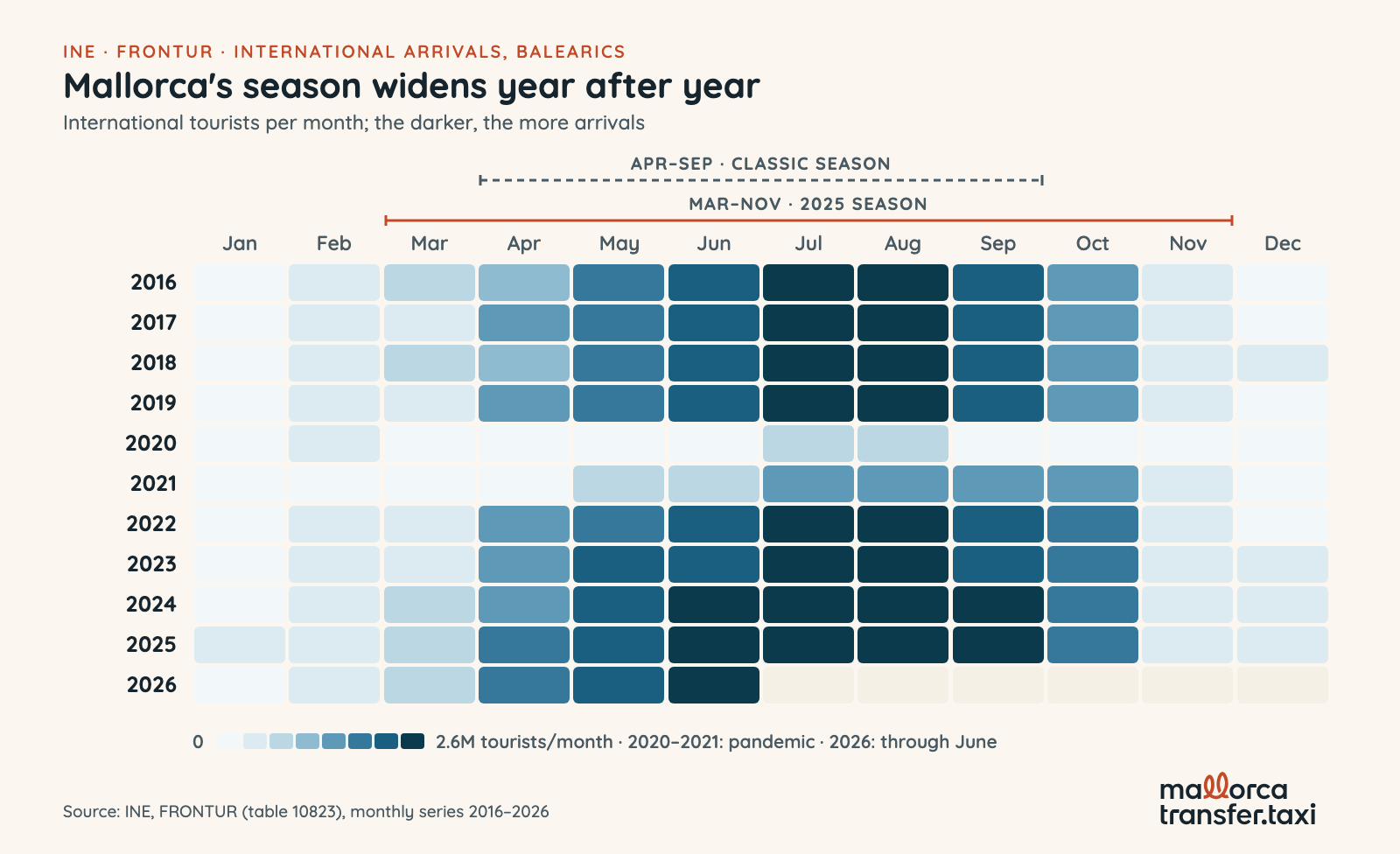
The 2025 season effectively started in March and didn’t wind down until mid-November. The Balearics received 423,285 international tourists in March 2025, 1,573,909 in October (almost as many as in May 2016) and 232,181 in November; and May 2025 already beat the arrivals of June 2016. In 2019 the island topped one million monthly arrivals for seven consecutive months (April to October) for the first time, and has repeated it every year since 2022; in 2016 it was six. Early 2026 points higher still: March 2026 grew 14% over March 2025. We have been running airport transfers here since 2017, and the change is easy to feel from the driver’s seat: our drivers now cover March and October pickups that simply did not exist five years ago.
The curve is widening: arrivals by month and year
International tourists arriving in the Balearic Islands each month (FRONTUR, INE). Tap a year to compare it with 2016 and run your cursor along the curve; the sand bands mark the shoulder months.
Source: INE, FRONTUR (table 10823). 2026: January–June, provisional data.
View data table
Ten years at a glance: the season heatmap
Each cell is one month; the darker, the more arrivals. Hover (or tap) any cell for the exact figure.
Source: INE, FRONTUR. “Shape of each year” colours every month relative to that same year's best month, so you can compare the season's silhouette without the effect of overall growth. 2020–2021: pandemic · 2026: through June.
Which months are growing fastest?
The edges of the season. Between 2016 and 2025, July arrivals grew 8.8% and August 10.4%: the peak is essentially flat, brushing its physical ceiling. Meanwhile April grew 75.8%, November 52.1% and December 92.2%. March and April are best read together (Easter jumps between them depending on the year): combined, they went from 1.16 to 1.78 million, up 53%. October + November went from 1.40 to 1.81 million (+29%). Mallorca’s growth no longer happens in summer; it happens around summer.
Arrivals growth 2016 → 2025, month by month
Percentage change for each month. Blue: months outside the peak; sand: June–August.
Source: INE, FRONTUR. Change in international arrivals by month, 2025 over 2016.
View data table
Is this new? The long series, back to 1999
Yes: the turning point is 2015. The INE hotel survey reaches further back than FRONTUR. The weight of March, April, October and November in the Balearics’ hotel guests bottomed out in 2015 (18.2% of the year) after fifteen years of concentration into high summer, and has climbed steadily since, to 20.5–21.1% in 2024–2025. The de-seasonalisation institutions had been calling for over decades only became visible in the data ten years ago, and it is accelerating.
Shoulder months' share of the hotel year, 1999–2025
Percentage of annual hotel guests arriving in March, April, October or November (EOH, INE). Excludes 2020–2021.
Source: INE, Hotel Occupancy Survey (table 1993 · travellers by month, Balearic Islands).
View data table
Who is stretching the season? Rural stays, holiday rentals and hotels opening earlier
The fastest-growing accommodation is precisely the least beach-bound. The 2025 monthly profile makes it plain: hotels concentrate 16.5% of their guests in August, but rural tourism spreads its year with much wider shoulders: it takes 26.7% of its annual guests in March, April, October and November, against 20.5% for hotels, and in April the countryside carries 50% more weight (9.4% of its year) than the average hotel (6.4%). The airport confirms the pattern: between 2015 and 2025, PMI passengers grew 63% in March and 60% in November, against 24.5% in August (AENA). That matches what we see season after season: the hotels we drop our customers at keep opening earlier and closing later than they did when we started in 2017.
How each type of accommodation spreads its year (2025)
Percentage of each category's annual guests arriving in each month. Balearic Islands.
Source: INE. EOH (hotels), EOTR (rural tourism), EOAT (tourist apartments), 2025.
View data table
The rural shoulder grows tenfold
Guests staying in Balearic rural tourism during March, April, October and November. From 12,841 (2004) to 138,849 (2025).
Source: INE, EOTR. In June 2026 there were 581 rural establishments open in the Balearics. Excludes 2020–2021.
View data table
The other engine is the holiday rental (ETV). Mallorca today has 103,915 licensed holiday-rental places, one in four of all licensed tourist beds on the island (25.1%), and the Consell registry dates the explosion precisely: of the places in force today, 37,448 were licensed by the end of 2015 and 88,185 by the end of 2017. Half of today’s holiday-rental stock was born in just two years, right before the Law 6/2017 moratorium; since then the stock has been frozen at around 104,000 places. Unlike the classic coastal hotel, a home doesn’t “close for the season”: it is available in March and in November.
The holiday-rental explosion: 2015–2017
Licensed ETV places in force in Mallorca, cumulative by their year of registration with the Consell.
Source: Consell de Mallorca holiday-rental registry (catalegdades.caib.cat), July 2026. This is the live registry classified by registration year (historical de-registrations don't appear), so early years are underestimated. Official 2024 stock: 103,915 places (Mar Balear report / AETIB).
View data table
Thirty years of countryside: agrotourism, interior and rural hotels
Places by type of rural accommodation in Mallorca, 1992–2025. Agrotourism went from 43 places to 5,981.
Source: Balearic tourism ministry (AETIB) yearbooks, 1992–2025 series. In 2025: 298 agrotourisms, 180 interior-tourism lodgings and 38 rural hotels.
View data table
Do people spend more outside the summer?
They spend more, and above all they spend better. Average daily spend per tourist in the Balearics went from €130 in 2016 to €197 in 2025 (+51%), and spend per person per trip from €1,001 to €1,340. In the shoulder months the jump is even bigger: March, April, October and November tourists left €4.584 billion in 2025, nearly double the €2.373 billion of 2016. The shoulder-season visitor (hiker, cyclist, golfer, remote worker) spends fewer days on the beach and more on restaurants, chauffeured cars and experiences.
Total tourist spending by month: 2016 vs 2025
Millions of euros spent by international tourists in the Balearic Islands (EGATUR, INE).
Source: INE, EGATUR (table 10839).
View data table
What does this mean if you’re visiting Mallorca (or make a living here)?
For the visitor, the best news in years: March, April, May, October and November now offer the whole island: hotels and restaurants open, 18–24°C and Tramuntana roads without queues, at flight and accommodation prices far below August. October is ideal for the northern beaches, from Alcúdia to Port de Pollença; April and May for hiking out of Sóller or Valldemossa. For those who work on the island, it means longer contracts and an airport already moving more than a million passengers in March and in November too. Wondering how long it takes to reach each area from that airport? We measured it route by route.
Two practical facts for planning a shoulder-season trip: May 2025 recorded more international arrivals (2,005,435) than June 2016 (1,945,565), and November already tops 232,000 tourists: the island doesn't close when summer ends. Our transfer service runs from 07:00 to 22:00, every month of the year.
Coming in the shoulder season? Your driver will be waiting all the same
Airport ↔ hotel transfers all over Mallorca, with the price locked when you book: the same in November as in August. Service from 07:00 to 22:00, all year round.
Methodology
Monthly series for the Balearic Islands downloaded from the INE Tempus API on 5 August 2026, plus the AETIB yearbooks, the Consell de Mallorca ETV registry and AENA’s series (cross-checked against Eurostat). “Shoulder months” = March + April + October + November; “peak” = June–August. 2020 and 2021 are excluded from the share series because of the pandemic. FRONTUR/EGATUR exist as monthly series from October 2015, so comparisons start in 2016, their first full year; 2026 figures are provisional. You are welcome to reuse this data citing the source and this analysis.
Frequently asked questions
What is Mallorca's tourist season now?
March to November. Since 2022 the Balearics have topped one million international arrivals a month for seven consecutive months every year (April–October; it had only happened once before, in 2019), and March and November already move between 232,000 and 423,000 tourists. The near-total shutdown is confined to December–February, and even those months are growing (+44% to +92% since 2016).
When is the best time to visit Majorca?
It depends what you want: for beaches without the crowds, May and October (in 2025 they received 21% and 38% fewer arrivals than August); for hiking and cycling, March, April and November. In all of those months the island is fully open, and they are exactly the months growing fastest since 2016. Our own transfer calendar says the same: after eight seasons on these roads, May and October are ordinary working months for our drivers, not the quiet edges of the year.
What is the weather like in Majorca in October?
October is still genuinely warm: Palma's historical average high is around 23°C and the sea holds at about 22–23°C, though showers are more likely than in high summer (AEMET climate normals). That's why it has become the big shoulder month: 1,573,909 international arrivals in October 2025. In March, by comparison, the average high is around 17–18°C: ideal for hiking and cycling rather than swimming.
Do shoulder-season tourists spend less?
No: they spend more per day than the historical average. Average daily spend in the Balearics reached €197 in 2025 (€130 in 2016), and total spending in the shoulder months has nearly doubled since 2016, to €4.584 billion (INE, EGATUR).
How many holiday-rental (ETV) places are there in Mallorca?
103,915 places in 2024, 25.1% of all licensed tourist accommodation on the island (Mar Balear report with AETIB data). According to the Consell de Mallorca registry, most were licensed between 2015 and 2017: from 37,448 cumulative places at the end of 2015 to 88,185 by the end of 2017, just before the Law 6/2017 moratorium.
Where does this data come from?
All from official statistics: Spain's INE (FRONTUR, EGATUR and the hotel, apartment and rural-tourism occupancy surveys, monthly series through June 2026), the Balearic tourism ministry's AETIB yearbooks, the Consell de Mallorca holiday-rental registry, and AENA's passenger series for Palma airport.
Sources
- INE, FRONTUR: tourist arrivals by region of destination (table 10823)
- INE, EGATUR: international tourist expenditure (table 10839)
- INE, Hotel Occupancy Survey: travellers by month (table 1993)
- INE, Rural Tourism Accommodation Occupancy Survey (table 2074)
- INE, Tourist Apartment Occupancy Survey (table 2046)
- Consell de Mallorca: holiday rental (ETV) registry (CAIB open data)
- AETIB / Balearic tourism ministry: Illes Balears tourism yearbooks
- AENA: Palma airport (PMI) traffic statistics

Ramon (Asen) Pons Miralles
Founder & DirectorFounder and Director of 89transfers with over 8 years of experience in Mallorca's transport and tourism industry. Born in Bulgaria and raised in Mallorca since age 4, Ramon combines deep local knowledge with modern business practices to deliver exceptional transfer services.
Credentials
Keep reading
20 August 2026 · 5 min read
Which taxi apps actually work in Mallorca?
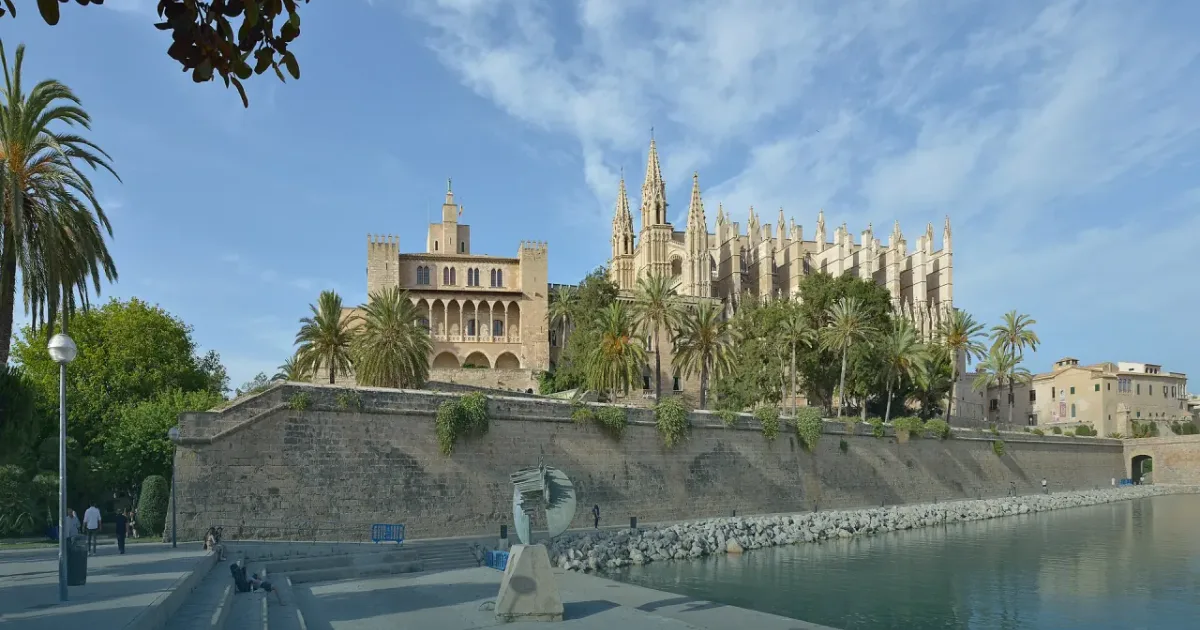
Land in Mallorca expecting one big ride-hailing app and you will spend your first evening confused. The island runs on municipal taxi licences, so the apps are local too: one for the whole island, two for Palma, a WhatsApp number and a lot of phone calls. We sorted them out, and checked which ones the 1,293 Reddit texts from our Uber study actually recommend.
Read the study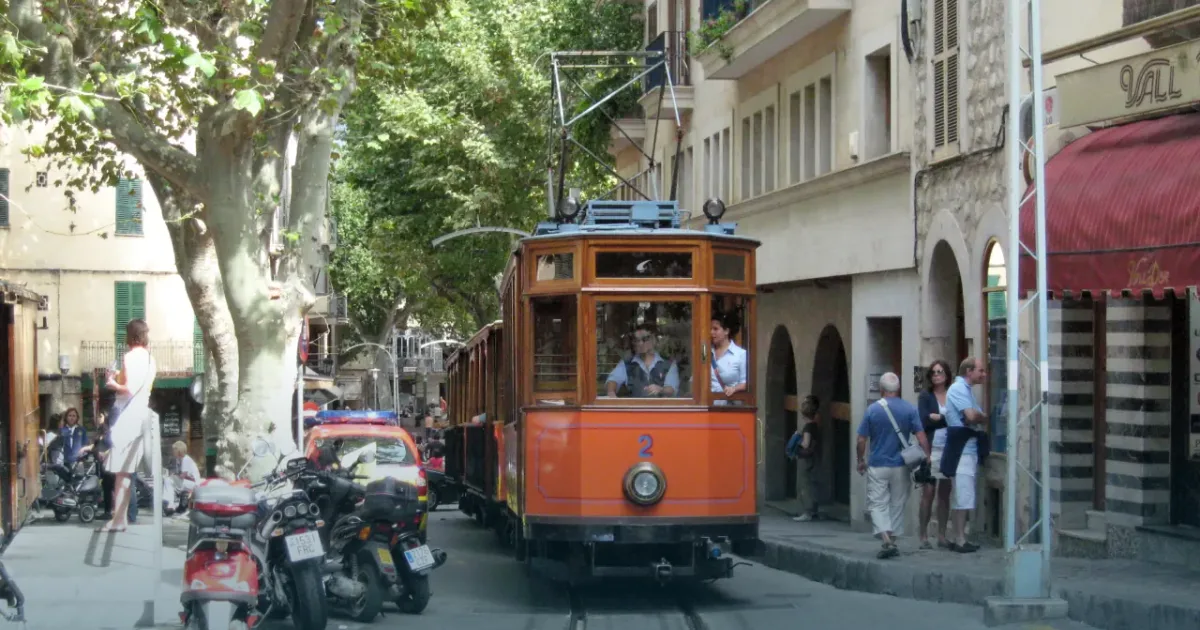
20 August 2026 · 6 min read
What does a taxi cost in Mallorca?
Since May 2025 nearly every taxi on Mallorca runs on the same published tariff, which means any fare on the island can be estimated with primary-school arithmetic. This guide gives you the whole price list: flag drop, price per kilometre, the night and weekend rate, every supplement that exists (and the ones that do not), plus a ready-made table so you know what 10, 20 or 60 kilometres should cost before you get in.
Read the study