How long does it take from Palma airport to each area?
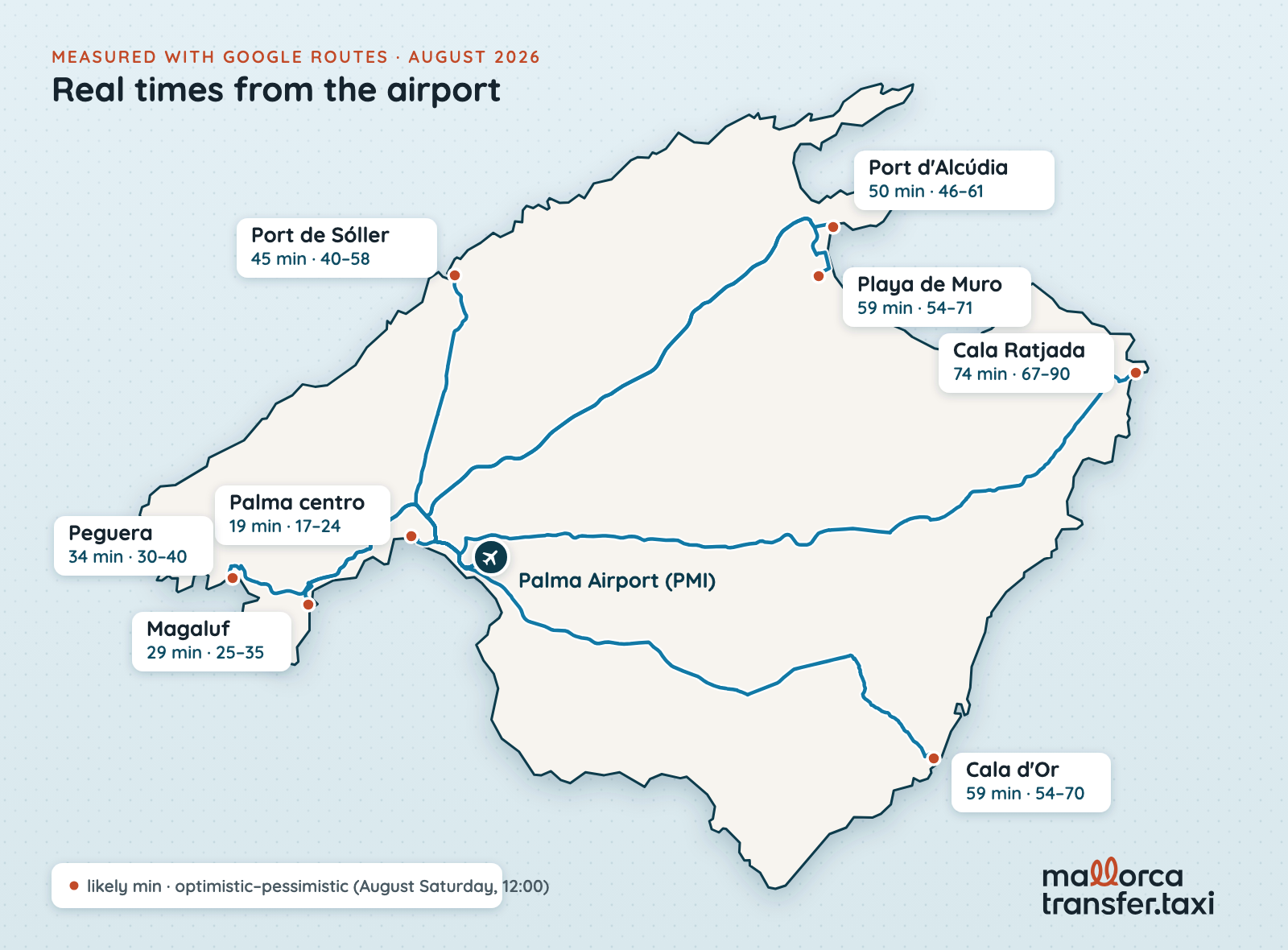
It depends on when you land, and that’s precisely the point. We measured 8 routes from the airport (PMI) with Google’s Routes API (the same one our pricing engine uses) in its three traffic scenarios: optimistic, likely and pessimistic. In normal August conditions: Palma centre in 19 minutes, Magaluf in 29, Peguera in 34, Port de Sóller in 45, Port d’Alcúdia in 50, Cala d’Or and Playa de Muro in 59, and Cala Ratjada in 74. But the full band is what matters: the same Cala Ratjada run goes from 67 minutes with luck to 90 without it.
Need the plain distance and typical time for a resort that is not among these eight? Our distance table for all 41 destinations from Palma airport covers the whole island, and our guide to official taxi fares from the airport puts a price on each of them.
How much can the same trip vary?
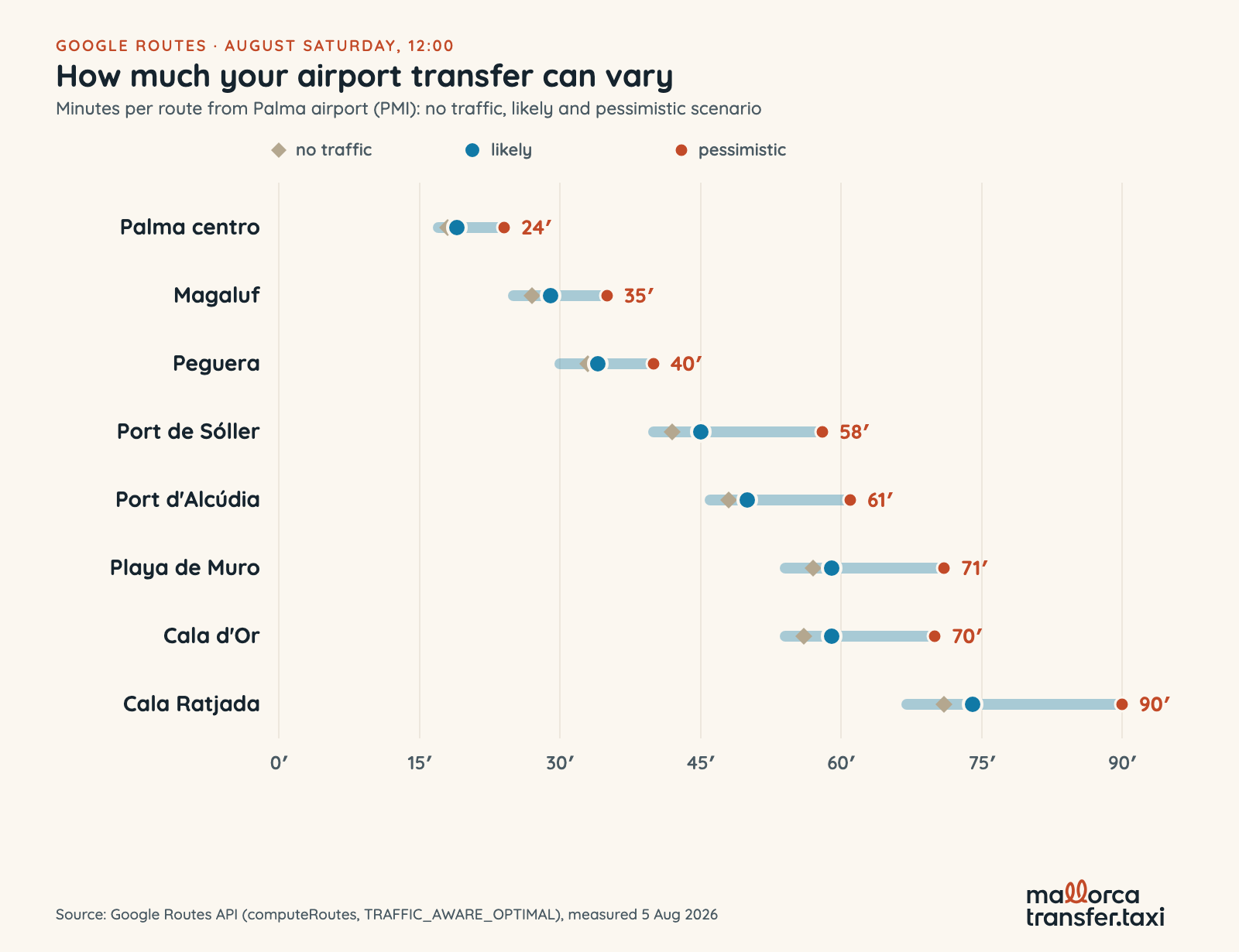
Up to 23 minutes between best and worst case. Every route has its own “traffic band”: the grey diamond is the no-traffic time, the blue dot the likely scenario and the terracotta one the pessimistic. The longer the band, the more treacherous the route. The longest bands belong to Port de Sóller, Cala Ratjada and the northern beaches. Sóller’s is no accident: its access road set traffic records in summer 2025 (up to 18,155 vehicles in a single July day), and overcrowding jams on the valley’s approaches make the news regularly. We drive that valley approach right through the season, and it is the clearest illustration of what a wide band means in practice: the same road that runs free at dawn can eat your whole margin by midday.
Pick your route and compare the four scenarios
From an August dawn (no traffic) to Saturday midday. Tap a route; run your cursor along each row for the three models.
Source: Google Routes API (computeRoutes, TRAFFIC_AWARE_OPTIMAL), measured 5 August 2026. Diamond: no traffic · band: optimistic→pessimistic · blue dot: likely.
View data table
When is the traffic worst?
August Saturdays between 10:00 and 14:00, and Friday evenings. It’s changeover day: tens of thousands of arrivals and departures on the same date, plus brand-new hire cars finding their feet on the Ma-19 and Ma-13. We have spent those Saturdays inside that traffic since 2017, and the minutes really go missing on the Ma-20 at rush hour, before the open motorway even starts. At 06:00, by contrast, every route runs at free-flow speed: a transfer to Alcudia at that hour takes the same in August as in November. And on a Tuesday midday in November, the whole island drives essentially delay-free. That calendar is no accident: Mallorca’s season now runs March to November, though the car peak still packs into high summer.
The peak toll: maximum delay over free flow
How much the pessimistic scenario of an August Saturday adds over the no-traffic time, per route.
Source: Google Routes API, 5 August 2026. Port de Sóller leads the relative delay (+38%): its access road broke traffic records in 2025, with recurring overcrowding jams. Cala Ratjada leads the absolute delay (+19 minutes).
View data table
Is Mallorca’s traffic getting worse?
Yes, and you don’t need to trust the vibe: there are traffic counts. The Consell de Mallorca publishes an annual map with the average daily traffic (IMD) of its network. We extracted the 2017–2024 series from its 150 stations: the Ma-13 exit from Palma went from 103,235 to 121,245 vehicles/day (+17%), the Ma-1 towards Andratx from 99,340 to 111,056 (+12%), and even the Ma-13 at Inca grew 19%. Across a fixed panel of 122 stations, 2024 traffic sits 14% above 2017 (the Consell itself publishes +11.5% through 2023 averaging its whole network). The ring road? It has no counting station, but the Consell officially puts it at 140,000–180,000 vehicles/day. Behind it all is a fleet that keeps growing: the Balearics went from 938,331 vehicles in 2015 to 1,141,473 in 2025 (+22%).
The Consell's traffic counts, 2017–2024
Vehicles per day at three key stations on the access roads. 2021 and 2023 can't be extracted from the official map (published as an image); 2020 is the COVID year.
Source: Consell de Mallorca traffic-count maps, 2017–2024, own extraction from the official PDFs' vector labels.
View data table
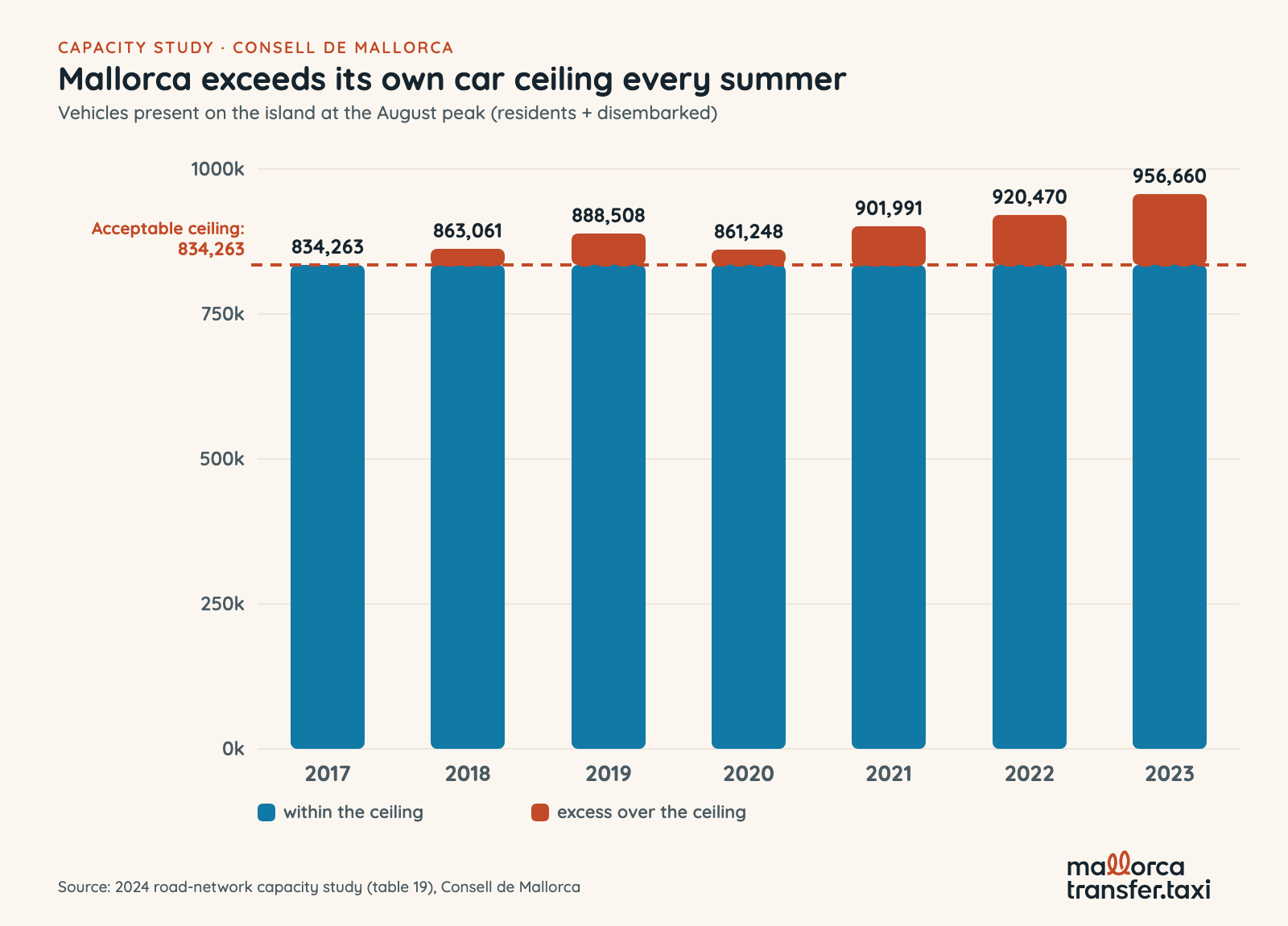
The most striking figure isn’t any single road: it’s the Consell’s own capacity study. Counting residents plus disembarked vehicles, at the August 2023 peak there were 956,660 vehicles present on Mallorca. The same study sets 834,263 as the ceiling the island’s road network can absorb. In other words: every summer since 2018, Mallorca has exceeded the number of cars its own government considers acceptable: by 122,000 vehicles in 2023.
What does this mean for your arrival (and your trip back)?
Three practical things. One: if you land on an August Saturday at midday, don’t plan with the map time; plan with the top of the band: Alcudia is 61 minutes, not 46. Two: the return to the airport is where traffic really hurts, because there’s a flight waiting; with these bands you can set your pickup time with real margin, not gut feeling. Three: the underlying problem (more cars every year on the same roads) won’t fix itself: the fewer hire cars enter the island in high August, the better for everyone using it. We plan our own day exactly that way: we track every flight we pick up, and it is why 98.6% of our pickups have been on time across more than 4,000 customers since 2021.
One figure to remember: at 06:00 in the morning, all 8 measured routes run at free-flow speed even in August. Mallorca's traffic isn't a wall; it's a tide with a timetable. Drivers who work these roads every day know the tide by heart, and set your pickup around your flight, not around the clock.
Your driver already plans around this traffic
The price is locked when you book: whatever the traffic does, that's our problem, not yours. Airport ↔ hotel transfers all over Mallorca, 07:00 to 22:00.
Methodology
Times measured on 5 August 2026 with Google’s Routes API (computeRoutes, TRAFFIC_AWARE_OPTIMAL preference), requesting each route under three traffic models (optimistic, best guess and pessimistic) for four departures: an August Saturday at 12:00 and at 06:00, an August Friday at 18:00 and a November Tuesday at 12:00. Important: these models are predictions built on Google’s recent traffic patterns, not a historical series: the Routes API cannot query the past. The 10-year evolution comes from official sources: the Consell de Mallorca’s annual traffic-count maps (2017–2024; 2021 and 2023 were published as raster images and are excluded for reliability, as is station PM652 for an anomaly; 2020 is no valid baseline because of COVID), the 2024 capacity study (table 19) and the DGT/IBESTAT vehicle fleet. You are welcome to reuse this data citing the source and this analysis.
Frequently asked questions
How long does it take from Palma airport to Alcudia?
Between 46 and 50 minutes in normal conditions (about 60 km on the Ma-13 motorway). In the worst scenario we measured (an August Saturday at midday, Google's pessimistic model) it rises to 61 minutes. Early in the morning it takes about 48 minutes with no traffic at all.
How long from Palma airport to Cala d'Or?
Between 54 and 59 minutes in normal conditions on the Ma-19 (about 60 km). On a peak August Saturday the pessimistic scenario reaches 70 minutes. This route's optimistic-to-pessimistic band is 16 minutes wide, worth building into your plan for the return trip to the airport.
And to Cala Ratjada?
It's the classic long run: 81 km and 67–74 minutes in normal conditions. In the worst August scenario, 90 minutes. For a return flight, book your pickup with that margin: the gap between best and worst case is 23 minutes.
Is driving in Majorca difficult? How bad is the traffic?
In summer, worse than most visitors expect: Palma's ring road (Ma-20) carries between 140,000 and 180,000 vehicles a day according to the Consell de Mallorca, and the Ma-13 exit from Palma went from 103,235 vehicles a day in 2017 to 121,245 in 2024 (+17%). The peaks are Saturday changeover days and Friday evenings. Outside summer, driving is genuinely relaxed. After eight seasons driving these roads ourselves, the stretch we would warn you about is Palma's ring road at rush hour: a few kilometres there can cost more time than the whole motorway run that follows.
Is Mallorca's traffic getting worse?
Yes, and the official numbers say so: traffic on the Consell's road network grew roughly 11–14% between 2017 and 2024 depending on the series, the Balearic vehicle fleet is up 18% since 2015 (1.1 million vehicles), and at the August 2023 peak there were 956,660 vehicles on Mallorca, 122,000 above the ceiling the Consell's own capacity study considers acceptable (834,263). The island has exceeded that ceiling every summer since 2018.
Sources
- Google Maps Platform: Routes API (computeRoutes, optimistic/pessimistic traffic models)
- Consell de Mallorca: annual traffic-count (IMD) maps of the road network, 2017–2024
- Consell de Mallorca: road network capacity study (Estudi de Càrrega, 2024), table 19
- Ara Balears: Sóller sets a traffic record in summer 2025
- Consell de Mallorca: press note with the ring road's daily traffic (Nov 2024)
- DGT (Spanish traffic authority): vehicle fleet, historical series by province
- IBESTAT: Balearic Islands vehicle fleet

Ramon (Asen) Pons Miralles
Founder & DirectorFounder and Director of 89transfers with over 8 years of experience in Mallorca's transport and tourism industry. Born in Bulgaria and raised in Mallorca since age 4, Ramon combines deep local knowledge with modern business practices to deliver exceptional transfer services.
Credentials
Keep reading

5 August 2026 · 8 min read
Summer no longer fits in summer
For decades, the island's season ran from April to September. Not any more. Official data draws a Mallorca that wakes up in March and doesn't switch off until November: the shoulder months are growing up to six times faster than July and August, rural tourism has multiplied its spring and autumn guests tenfold, and every visitor now spends a record €197 a day.
Read the study
20 August 2026 · 5 min read
Which taxi apps actually work in Mallorca?
Land in Mallorca expecting one big ride-hailing app and you will spend your first evening confused. The island runs on municipal taxi licences, so the apps are local too: one for the whole island, two for Palma, a WhatsApp number and a lot of phone calls. We sorted them out, and checked which ones the 1,293 Reddit texts from our Uber study actually recommend.
Read the study